Bethany Carlson Bethany Carlson

The best waterproof walkie talkies for lifeguards and public pools

Confidence doesn’t always arrive with a bold entrance. Sometimes, it builds quietly, step by step, as we show up for ourselves day after day. It grows when we choose to try, even when we’re unsure of the outcome. Every time you take action despite self-doubt, you reinforce the belief that you’re capable. Confidence isn’t about having all the answers — it’s about trusting that you can figure it out along the way.

The key to making things happen isn’t waiting for the perfect moment; it’s starting with what you have, where you are. Big goals can feel overwhelming when viewed all at once, but momentum builds through small, consistent action. Whether you’re working toward a personal milestone or a professional dream, progress comes from showing up — not perfectly, but persistently. Action creates clarity, and over time, those steps forward add up to something real.

You don’t need to be fearless to reach your goals, you just need to be willing. Willing to try, willing to learn, and willing to believe that you’re capable of more than you know. The road may not always be smooth, but growth rarely is. What matters most is that you keep going, keep learning, and keep believing in the version of yourself you’re becoming.

Why Waterproof Walkie Talkies Are Essential Lifeguard Equipment

Two-way radios sit near the top of any serious lifeguard equipment list, right alongside rescue tubes, whistles, backboards, and first aid kits. A guard scanning their zone can't leave the stand to relay a message, and a whistle only communicates so much. Radios let your team coordinate rotations, call for backup during a rescue, reach the front desk or facility manager instantly, and execute a clear chain of communication when every second counts.

The problem is that ordinary consumer radios aren't built for this environment. A pool deck combines nearly everything that kills electronics: constant splash exposure, chlorinated water, direct sun and extreme heat, humidity in indoor natatoriums, and hard drops onto concrete. A radio that would survive years in an office or warehouse can die in a single summer at a pool. That's why waterproof walkie talkies aren't a luxury line item in your pool safety equipment budget — they're the baseline.

What IP Ratings Actually Mean (IPX7 vs. IP67, Explained)

Every waterproof claim comes down to an IP (Ingress Protection) rating — two digits that tell you exactly how sealed a device is. The first digit is dust protection (6 is fully dust-tight). The second is water protection. An "X" means that category simply wasn't tested.

RatingDustWaterPool Deck VerdictIPX4 / IP54Untested / limitedSplashes from any directionSurvives spray, not a dunk. Risky for guards.IPX7UntestedSubmersion, 1 meter for 30 minutesWater-safe, but dust/sand can still get in.IP67Fully dust-tightSubmersion, 1 meter for 30 minutesThe pool standard. Buy this.IP68Fully dust-tightDeeper/longer submersion (varies)Overkill for most pools, common in commercial radios.

For lifeguard use, treat IP67 as your minimum spec. "Water-resistant" and "weatherproof" are marketing terms, not ratings — if a radio doesn't publish an IP rating, assume it won't survive the season.

One caveat manufacturers won't volunteer: IP ratings are tested in fresh water. Chlorinated and salt-system pool water is harsher on seals and contacts over time. If a radio takes a full dunk in the pool, rinse it briefly in fresh water and dry it before putting it back in rotation. That one habit meaningfully extends fleet life.

The Best Waterproof Walkie Talkies for Lifeguards in 2026

Every pick below carries a true IP67 rating, works without complicated setup, and has a track record in wet, high-abuse environments.

1. Motorola Talkabout T600 H2O — Best Overall for Most Pools

The T600 H2O is the default answer for a reason. This Motorola waterproof walkie talkie is fully IP67 sealed, and if it goes in the pool it floats face-up with a water-activated light that switches on automatically — your guard fishes it out of the gutter and keeps working. It runs on a rechargeable battery pack or standard AA batteries, which is a bigger deal than it sounds: on a double-session swim meet day, swapping in AAs beats waiting on a charger. Built-in NOAA weather channels matter for outdoor pools running lightning protocols.

Its one real weakness — modest transmission range compared to high-powered trail radios — is irrelevant at a pool. Reviewers consistently measure 2 to 4 miles of real-world range; your facility needs a few hundred yards. At roughly $90 a pair, it's the best value-to-durability ratio in the category.

Best for: Most public pools and summer facilities that want reliable, license-free radios without overthinking it.

2. Cobra ACXT1035R FLT — Best Feature Set for Loud, Busy Decks

The Cobra ACXT1035R FLT is IP67 rated, floats, and adds features that are genuinely useful poolside rather than gimmicks. A "burp" function vibrates water out of the speaker grill after a dunk so transmissions stay clear. A vibrate alert means guards feel incoming calls in echoing indoor natatoriums where audio gets lost. And the Rewind-Say-Again function replays the last transmission — helpful when a message comes through mid-whistle. It also monitors NOAA weather channels and includes an LED light.

It typically runs around $130 a pair, a step up from the Motorola, and worth it for high-traffic facilities where missed transmissions are a real operational problem.

Best for: Indoor natatoriums, high-bather-load pools, and facilities that want every communication redundancy.

3. Retevis RT49P — Best Budget Pick for Outfitting a Full Guard Staff

If you need eight or twelve radios rather than two, the per-unit price starts to matter more than any single feature. The Retevis RT49P is a license-free FRS radio with a full IP67 rating, a floating design with a water-activated locator light, NOAA weather alerts, and an SOS signal function. It charges over USB and takes replaceable batteries.

It won't feel as refined as the Motorola or Cobra, but it covers every pool-critical spec at a price that makes fleet-wide deployment (plus spares in the office) realistic on a parks-and-rec budget.

Best for: Municipal pools and summer programs outfitting large seasonal guard staffs.

4. DeWalt DXFRS800 — Most Rugged for Waterparks and Heavy Abuse

DeWalt builds these for construction sites, which turns out to be excellent preparation for a waterpark. The DXFRS800 pairs an IP67 rating with a thick rubberized shell that shrugs off drops and stays grippy in wet hands — reviewers note zero issues after rainstorm testing and full submersion. It's a license-free FRS radio with optional VOX hands-free operation, and it's heavier than the others here, which is the tradeoff for the armor.

Best for: Waterparks, slide towers, and any facility where radios take constant physical abuse, not just water exposure.

5. Commercial Business-Band Radios — Best for Large Municipal Aquatic Centers

Many city aquatic programs skip consumer radios entirely and standardize on commercial two-way radios from Motorola's or Kenwood's business lines — the same radios their parks, maintenance, and facilities departments already run. These operate on FCC business-band frequencies (your city likely already holds the license), offer better audio and battery systems, and support a deep accessory ecosystem, including waterproof speaker microphones that clip at the shoulder so the radio itself stays protected. Waterproof ratings vary by model in the commercial lines, so confirm the IP spec before purchasing — don't assume "commercial" means "submersible."

Best for: Municipal aquatic centers standardizing communications across multiple facilities and departments.

The Licensing Question Most Lists Get Wrong

Here's a detail that matters for facilities but rarely gets explained. Consumer radios come in two flavors: FRS and GMRS. FRS radios are license-free for everyone — including businesses and city facilities — and their power limit delivers far more range than any pool campus needs. GMRS radios, the higher-powered ones outdoor sites rave about, are licensed to individuals and their families, not to businesses. A public pool generally can't legally operate GMRS radios under a staff member's personal license.

So for a facility, the practical choice is simple: license-free FRS radios (every consumer pick above) or true business-band commercial radios under your organization's FCC business license. Skip GMRS.

Your Radio Is Only as Safe as Where You Put It

Here's the part nobody talks about: most pool radios don't die from swimming. They die from falling. A radio balanced on the arm of a guard chair, wedged next to a rescue tube, or set on the platform during a rotation is one bump away from a six-foot drop onto concrete — or a slide into the gutter. Even an IP67 radio loses that fight often enough, and a cracked case voids the waterproofing entirely.

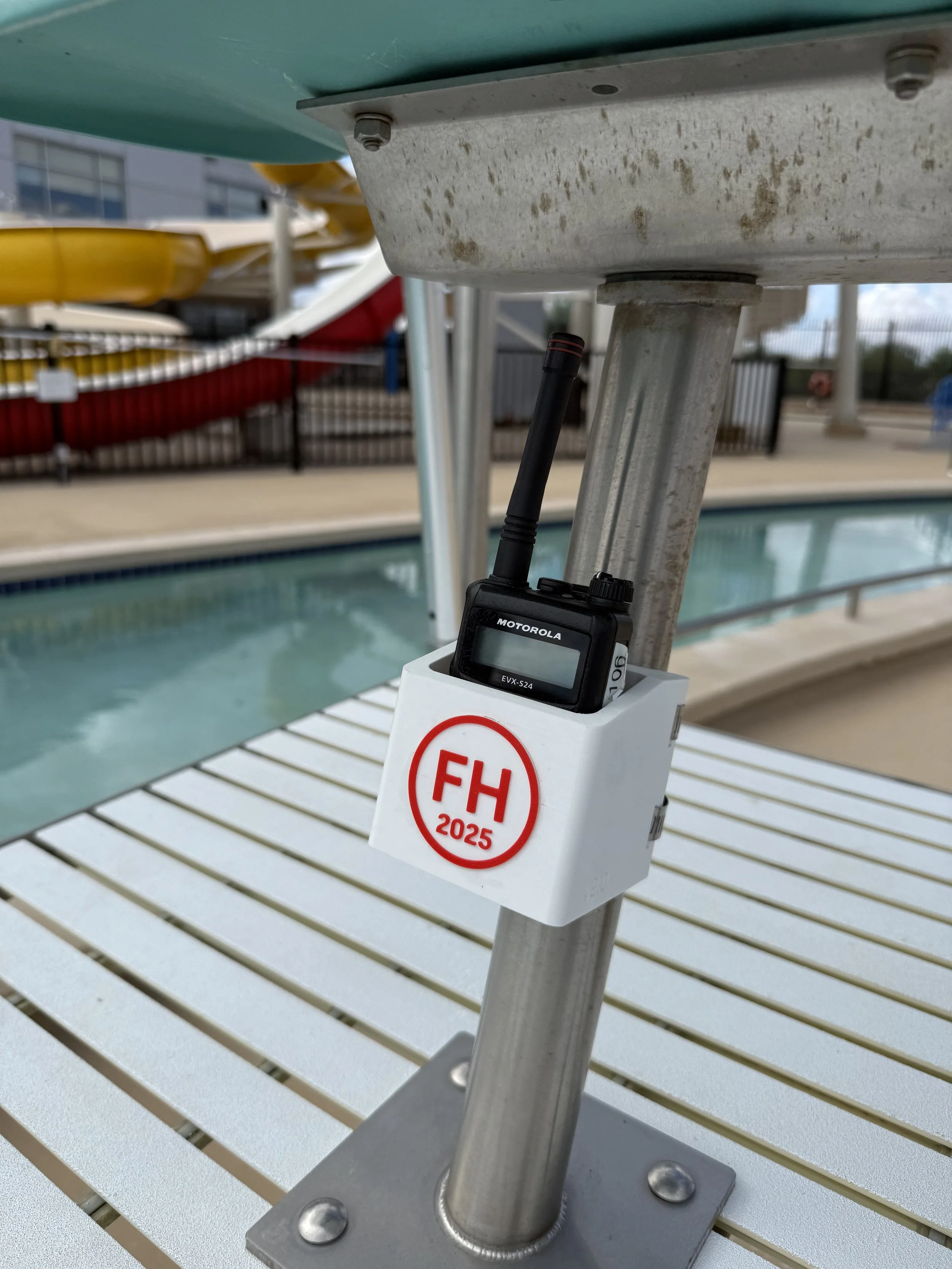
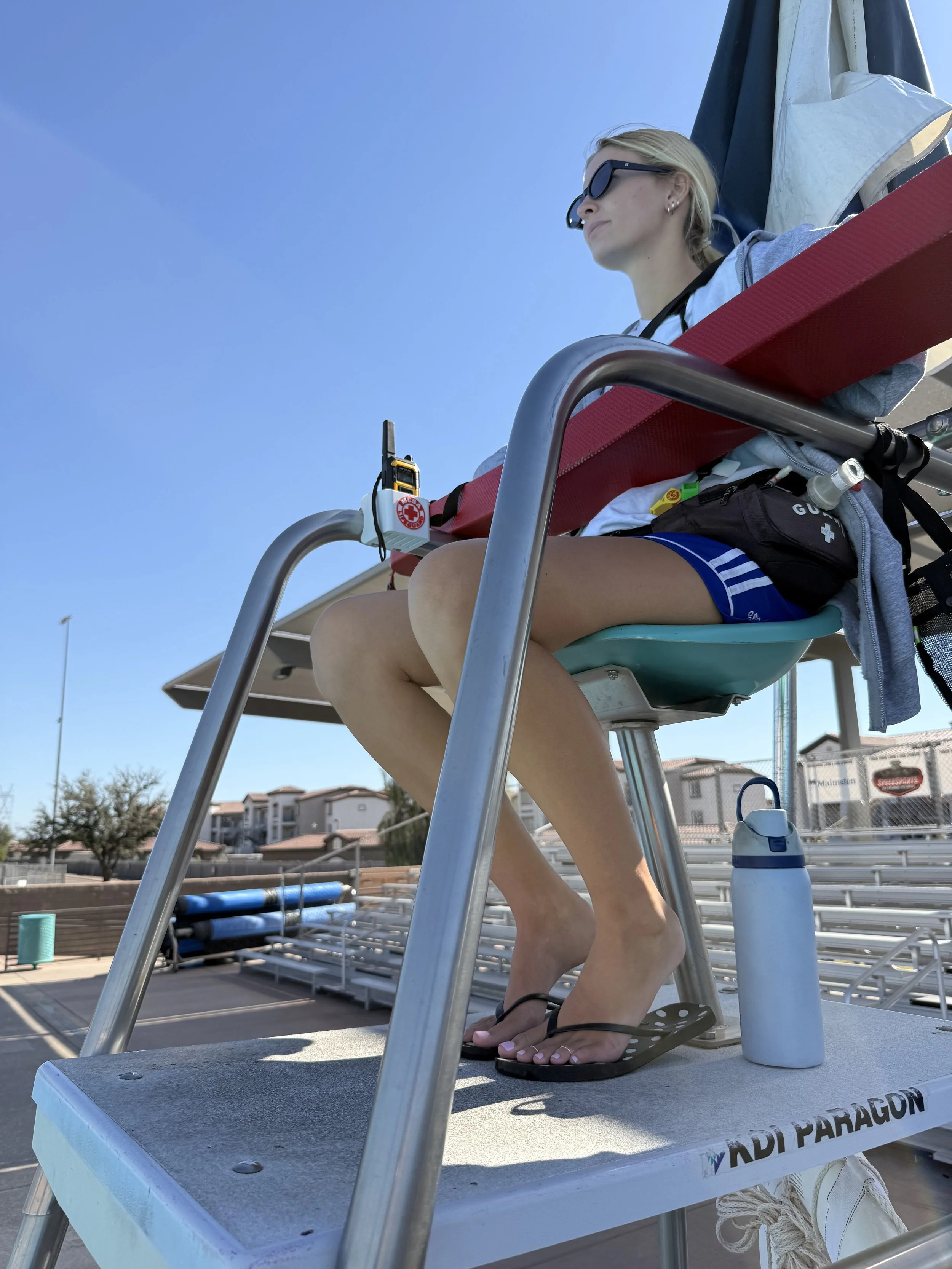
A dedicated walkie talkie holder mounted to the guard chair solves this. The radio has a home at the guard's fingertips, it's never underfoot during a rotation, and it stops taking drops. That's exactly why we build them.

Penny Next holders are made for lifeguards, by lifeguards. Each holder is custom-designed for your facility's specific radios and mounts to Paragon chairs, S.R. Smith chairs, and more, in vertical or horizontal orientation. They're printed in PETG — a durable filament with a heat deflection temperature around 158°F, built for pool decks that bake all summer — and mounted with two stainless steel hose clamps. Every holder comes with a custom radio fit and your facility's logo. They're already trusted on the stands of the City of Chandler, Mesa, Avondale, and Glendale.

Frequently Asked Questions

Do lifeguards really need waterproof walkie talkies?
Yes. Radios are core lifeguard equipment for coordinating rescues, rotations, and emergency action plans — and a pool deck will destroy non-waterproof electronics through splash, humidity, and drops. IP67-rated radios are the practical minimum.

What waterproof rating do I need for a pool radio?
Look for IP67: fully dust-tight and rated for submersion in 1 meter of water for 30 minutes. Splash-resistant ratings like IPX4 survive spray but not a dunk in the pool.

Do waterproof walkie talkies float?
Not all of them — waterproof and buoyant are separate features. The Motorola T600 H2O, Cobra ACXT1035R FLT, and Retevis RT49P all float, and the Motorola and Retevis add a water-activated light so a dropped radio is easy to spot.

Do we need an FCC license for pool radios?
Not for FRS radios, which includes every consumer model in this guide — they're license-free even for business and municipal use. Commercial business-band radios require an FCC business license, which most cities already hold. Avoid GMRS radios for facility use, since those licenses cover individuals and families, not organizations.

How do we protect radios from chlorine and drops?
Rinse radios in fresh water after any full submersion in pool water, dry them before charging, and mount a holder on each guard chair so radios stop living on chair arms and platforms. Preventing drops does more for fleet lifespan than any spec sheet.

The Bottom Line

For most pools, the Motorola Talkabout T600 H2O is the pick: IP67 waterproof, floating, license-free, and affordable enough to outfit every stand. Step up to the Cobra ACXT1035R FLT for loud indoor facilities, down to the Retevis RT49P for big seasonal staffs, or over to commercial business-band radios if your city is standardizing across departments.

Then protect the investment. A waterproof radio in a chair-mounted holder is a communication system; a waterproof radio balanced on a chair arm is a countdown. If your guard chairs are still improvising, request a free Penny Next demo holder and see the difference one season makes.

Read More